
.png)
10 Best Home Gym Equipment on Amazon (2026): Peloton, NordicTrack, Concept2 & More Reviewed
Last Updated: October 2026
Home fitness has permanently changed. What started as a pandemic necessity has evolved into a genuine lifestyle shift — and the equipment has gotten dramatically better. Today's home gym machines connect to live and on-demand classes, fold away into closets, fit under standing desks, and deliver the kind of build quality that used to be reserved for commercial gyms. The result? A home setup that can genuinely replace a $150/month gym membership.
But here's the problem: Amazon is now flooded with fitness equipment. Some of it is exceptional. Some of it is overpriced junk with fake review scores. And the price range is enormous — from an $18 yoga block to a $1,695 Peloton. If you don't know exactly what to look for, it's incredibly easy to waste hundreds of dollars on a machine that ends up as an expensive clothes rack in your spare room.
That's where this guide comes in. We've combed through Amazon's fitness category and pulled together 10 pieces of equipment that are genuinely worth your money — the cardio machines, strength tools, and small accessories that deliver real results and hold up over time. For each one, we've broken down exactly why it's the best in its category, given you 5 honest pros and 3 real cons, and included a direct "Buy Now" link so you can check current pricing in seconds.
Whether you're building a full garage gym from scratch or just want one great cardio machine and a few smart accessories, this list has you covered.
- Peloton Exercise Bike — Best Overall Smart Bike
- NordicTrack T Series Treadmill — Best Value Treadmill
- Concept2 RowErg — Best Rowing Machine
- Under Desk Elliptical — Best for Seniors & Desk Workers
- CAP Barbell Folding Mat — Best Floor Protection
- TRX All-In-One Home Gym — Best Portable Strength System
- Walking Pad Treadmill (12% Auto Incline) — Best Under-Desk Cardio
- FLYBIRD WB5 Weight Bench — Best Adjustable Bench
- NordicTrack Commercial Series Treadmill — Best Premium Treadmill
- Gaiam Yoga Block — Best Small Accessory
Quick Comparison Table
| # | Product | Price | Best For |
|---|---|---|---|
| 1 | Peloton Exercise Bike | $1,695.00 | All-in-one smart cardio |
| 2 | NordicTrack T Series Treadmill | $999.00 | Budget-friendly running |
| 3 | Concept2 RowErg | $990.00 | Low-impact full-body cardio |
| 4 | Under Desk Elliptical | $84.98 | Seniors & desk workers |
| 5 | CAP Barbell Folding Mat | $36.97 | Floor protection |
| 6 | TRX All-In-One System | $189.95 | Travel & bodyweight strength |
| 7 | Walking Pad Treadmill | $335.25 | Walking while working |
| 8 | FLYBIRD WB5 Weight Bench | $149.98 | Home strength training |
| 9 | NordicTrack Commercial Series | $1,599.00 | Serious runners |
| 10 | Gaiam Yoga Block | $18.99 | Yoga, Pilates & mobility |
The 10 Best Home Gym Equipment Picks on Amazon

Why It's Best
The Peloton Bike remains the gold standard for at-home cardio — and it's not just about the brand name. What separates Peloton from every $400 spin bike on Amazon is the complete ecosystem: a large rotating HD touchscreen built directly into the frame, magnetic resistance that adjusts smoothly and quietly, and a library of thousands of live and on-demand classes led by instructors who are genuinely motivating. The bike itself is built like commercial equipment, with a sturdy steel frame, adjustable seat and handlebars, and a footprint that fits comfortably in a bedroom or corner of a living room.
Where Peloton truly wins is accountability. The leaderboard, streak tracking, and instructor shout-outs create the kind of engagement that keeps people coming back — which is ultimately the single most important factor in any fitness purchase. You're not just buying a bike; you're buying a reason to use it. If you've ever bought a cheap exercise bike and abandoned it after three weeks, this is the fix. It's expensive, yes — but it's the most reliable "will I actually use this?" answer in home fitness.
✅ 5 Pros
- Best-in-class content library: Thousands of live and on-demand rides, plus strength, yoga, and meditation classes on the same screen.
- Premium build quality: Heavy steel frame, smooth magnetic resistance, and a quiet belt drive that won't disturb your household.
- Outstanding engagement: Leaderboards, streaks, and community features make it genuinely hard to skip a workout.
- Compact footprint: Smaller than most treadmills and fits in a bedroom, apartment, or garage corner.
- Strong resale value: Peloton bikes hold their value far better than budget competitors if you ever upgrade.
❌ 3 Cons
- Subscription required for full experience: The all-access membership is a separate monthly cost, and the bike is far less compelling without it.
- High upfront price: At $1,695, it's a serious investment — and financing adds interest if you spread payments.
- Not ideal for outdoor-focused cyclists: It's an indoor-only experience with no real road-feel simulation like a smart trainer offers.

Why It's Best
The NordicTrack T Series is the smartest treadmill purchase for most people — full stop. At under $1,000, you get a machine from a legacy fitness brand with real engineering behind it, not a no-name import. The T Series lineup (T5 through T16) lets you scale up depending on your budget and screen-size preference, but every model shares the same core DNA: a powerful motor, NordicTrack's FlexSelect cushioning to protect your joints, and the SpaceSaver folding design that lets you lift the deck vertically to reclaim floor space.
What makes the T Series genuinely special is the iFit integration. On compatible models, the treadmill automatically adjusts speed and incline to match on-screen routes filmed around the world — you're not just running on a belt, you're "running" through the Swiss Alps or the streets of Tokyo while an instructor coaches you. For a sub-$1,000 machine, that's remarkable. It's the ideal pick for anyone who wants a real running treadmill but can't justify spending $2,500+ on a commercial-grade machine.
✅ 5 Pros
- Exceptional value: Full-featured treadmill under $1,000 with 23% savings at time of writing.
- SpaceSaver folding design: Deck folds vertically with a soft-drop system — ideal for apartments and small rooms.
- FlexSelect cushioning: Noticeably easier on knees and ankles than rigid budget treadmills.
- iFit integration: Automatic speed and incline control with global route workouts on compatible models.
- Trusted brand with service network: NordicTrack has real warranty support and parts availability, unlike generic imports.
❌ 3 Cons
- Model confusion: The T5, T6.5s, T7, T10, and T16 differ significantly in screen size, motor power, and incline range — you need to read the specs carefully before buying.
- iFit is a paid subscription: Many of the best features require a membership after the trial period ends.
- Not built for heavy daily running: Base models are great for walking and jogging, but serious marathon trainers should step up to the Commercial Series.

Why It's Best
Ask any serious rower, CrossFit box owner, or collegiate rowing coach what erg they use, and you'll get the same answer every time: Concept2. The RowErg is the industry standard for a reason — it's bombproof, it's repairable, and its performance data is the benchmark that the entire sport uses. The PM5 monitor is legendary for its accuracy and versatility, tracking split times, stroke rate, watts, calories, and heart rate, and connecting to apps like ErgData and Strava.
Mechanically, the RowErg uses air resistance via a flywheel and damper, which means the harder you pull, the more resistance you get — a natural, self-regulating feel that's far more satisfying than magnetic rowers. It separates into two pieces in seconds for storage and stands upright against a wall. There's no subscription, no screen to break, and no software that will be abandoned in three years. This is a buy-it-once piece of equipment that will outlast most of your furniture. For low-impact, full-body cardio that trains your legs, back, core, and arms simultaneously, nothing else comes close at this price.
✅ 5 Pros
- Industry-standard build quality: Used in gyms, boathouses, and competitions worldwide — it simply does not break.
- PM5 monitor is elite: Highly accurate data, Bluetooth and ANT+ connectivity, and compatibility with major fitness apps.
- No subscription required: All core functionality works forever with zero monthly fees.
- Full-body, joint-friendly workout: Delivers serious cardio and strength work with virtually no impact on knees or hips.
- Splits in two for storage: Breaks down and stands upright in a closet or corner in under a minute.
❌ 3 Cons
- Requires technique: Poor rowing form can strain your lower back — most beginners need to watch a few tutorials before going hard.
- Air resistance is loud: It's noticeably noisier than magnetic rowers, which matters in apartments or shared living spaces.
- Bare-bones aesthetics: No built-in screen or entertainment system — you'll need a tablet, phone, or TV for distraction during long sessions.
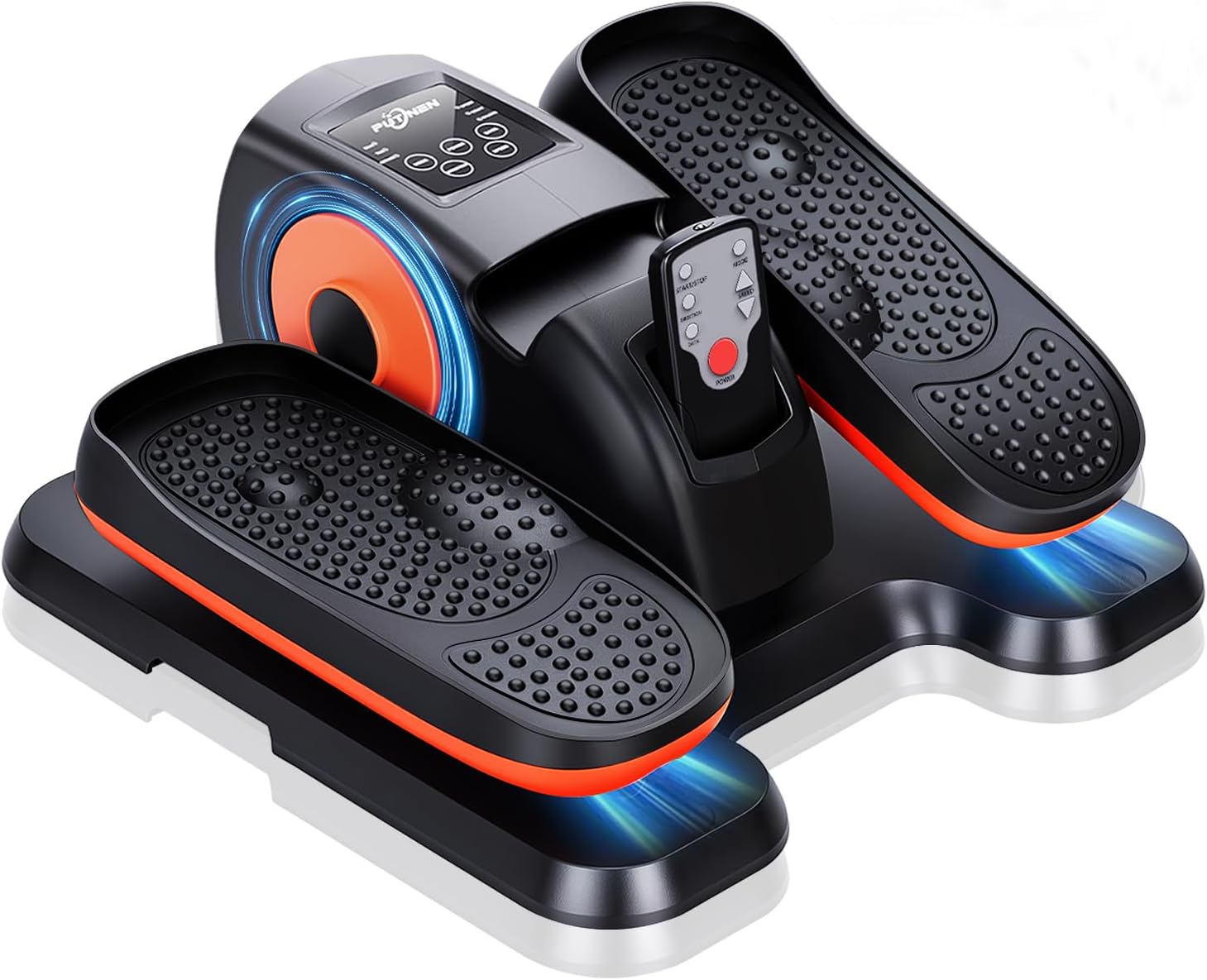
Why It's Best
Not everyone needs a $1,700 bike. For seniors, people recovering from injury, or anyone who sits at a desk for eight hours a day, the biggest fitness win is simply more movement — and that's exactly what this under-desk elliptical delivers. It's a compact, motorized leg exerciser that lets you pedal while seated on the couch, at your desk, or in a chair, improving circulation and keeping your joints active without any impact or strain.
The standout features here are the 100% no-assembly design (it arrives ready to use, which is enormous for older users), the remote control so you don't have to bend down to change settings, and 12 speed levels covering both passive motorized movement and active resistance pedaling. It runs quietly enough to use during phone calls or TV, and the compact footprint means it tucks under a desk or beside an armchair. At under $85, it's the lowest-barrier entry into daily movement on this entire list — and for the right person, it's genuinely life-improving.
✅ 5 Pros
- Zero assembly required: Arrives fully built — plug in and start pedaling, which is ideal for seniors and non-DIY users.
- 12 speed settings with remote: Easy to adjust without bending or reaching, including passive motorized modes.
- Extremely quiet operation: Won't disrupt work calls, TV, or other people in the room.
- Excellent for circulation and joint health: Low-impact movement helps with stiffness, swelling, and mobility.
- Remarkable value: Under $85 for a motorized exerciser is genuinely budget-friendly.
❌ 3 Cons
- Not a real cardio workout: It's for circulation and light movement — don't expect meaningful calorie burn or cardiovascular conditioning.
- Height and fit limitations: Taller users or those with long legs may find the pedal range cramped under a standard desk.
- Can slide on smooth floors: Some users report the unit shifting on hardwood or tile — a non-slip mat underneath helps.

Why It's Best
This is the most underrated item on the entire list. Everyone budgets for the flashy machines and forgets the foundation — and then their $1,700 Peloton ends up denting the hardwood or their knees end up aching after every floor exercise. The CAP Barbell folding mat solves both problems at once. At 2 inches thick, it provides serious cushioning for yoga, Pilates, stretching, core work, and bodyweight training, while protecting your floors from dumbbells, benches, and equipment feet.
The folding design is the killer feature. Unlike a rolled yoga mat that you have to wrestle back into shape, this folds flat into compact sections for storage in a closet or under a bed. The anti-tear surface holds up to repeated use and heavy equipment, and it's available in multiple sizes and colors to match your space. For under $40, it's the cheapest way to make your home gym safer, quieter, and more comfortable — and if you're doing floor work on bare hardwood or concrete, you'll feel the difference on day one.
✅ 5 Pros
- 2-inch thickness: Genuinely supportive for knees, elbows, and spine during floor exercises.
- Protects floors and equipment: Shields hardwood, tile, and carpet from weights and machine feet.
- Folds flat for storage: Far easier to store and set up than a rolled mat.
- Durable anti-tear surface: Holds up to repeated folding and heavy use.
- Multiple sizes and colors: Easy to match your space and training needs.
❌ 3 Cons
- Too thick for balance poses: At 2 inches, it's unstable for yoga standing balances — use a thin mat for that instead.
- Folds create slight gaps: The seams between sections can be felt during floor work unless fully flattened.
- Foam can compress over time: Heavy, repeated loading in the same spot may reduce cushioning after extended use.

Why It's Best
TRX invented suspension training, and the All-In-One system is the most complete package they sell. It includes the TRX Suspension Trainer, both an indoor door anchor and an outdoor anchor, and access to TRX's training content — so you can do a full-body strength and HIIT workout in a hotel room, a park, or your living room with nothing but a door or a tree.
What makes suspension training so effective is that it turns bodyweight exercises into adjustable resistance training. By changing your body angle, you can make a row, chest press, squat, or lunge easier or harder instantly — no dumbbells required. That makes it ideal for beginners who can't yet do a pull-up and for advanced athletes who want to add instability and core work. The whole kit weighs about two pounds and fits in a stuff sack, making it the single most portable piece of "equipment" on this list. If you travel frequently or live in a small apartment, TRX delivers more workout per square inch than anything else here.
✅ 5 Pros
- Incredibly portable: Packs into a small bag and sets up anywhere with a door or a sturdy anchor point.
- Adjustable resistance without weights: Change difficulty instantly by adjusting body angle — great for all levels.
- Full-body strength and core work: Trains stability and functional movement better than most machines.
- Indoor and outdoor anchors included: Use it at home, in a park, or in a hotel room.
- Genuine brand quality: TRX is the original suspension trainer with excellent build and warranty support.
❌ 3 Cons
- Learning curve: Suspension exercises require practice to get straps adjusted correctly and form dialed in.
- Limited heavy strength potential: You can't progressively overload with heavy weights the way you can with barbells or dumbbells.
- Anchor point required: You need a solid door, beam, or tree — not every space works.

Why It's Best
The walking pad category has exploded, and this model stands out for one specific reason: a 12% automatic incline. Most under-desk treadmills are completely flat, which means walking on them burns surprisingly few calories and doesn't engage your glutes or calves meaningfully. Adding a real incline transforms a walking pad from a novelty into a genuinely effective low-impact cardio tool — you can hit a proper heart-rate zone in 30 minutes without running or leaving your desk.
It's also designed to be practical: it's slim enough to slide under a standing desk or a bed, quiet enough for calls, and controllable via remote or app. The speed range suits both slow "walking meetings" and brisk incline walks. At $335, it occupies a sweet spot — significantly cheaper than a full treadmill, significantly more effective than a flat walking pad, and small enough that it doesn't require a dedicated room. If your biggest fitness barrier is the number of hours you spend sitting, this is the highest-leverage purchase on the list.
✅ 5 Pros
- 12% auto incline: Rare in this category and dramatically improves workout effectiveness and calorie burn.
- Space-saving design: Slides under a standing desk or bed when not in use.
- Quiet motor: Suitable for use during work calls, meetings, or while watching TV.
- Great for daily step goals: Realistically gets you to 8,000–10,000 steps without leaving home.
- Mid-range price with premium features: Incline and auto-adjust at a fraction of full treadmill cost.
❌ 3 Cons
- Not for running: Speed range is designed for walking only — runners need a proper treadmill.
- No handrails: Balance can be an issue for older users or at higher incline settings.
- Deck length limits stride: Taller users may find the belt shorter than ideal for a natural walk.

Why It's Best
A weight bench is the backbone of any home strength setup, and the FLYBIRD WB5 is the best value adjustable bench on Amazon. The headline is the ASTM-certified 800 lb weight capacity — certified, not just claimed — which gives you genuine confidence under heavy loads. It offers a full FID range (flat, incline, decline) from 90° to -30°, so you can do everything from flat bench press to incline dumbbell work to decline situps.
Two details push it ahead of the competition. First, the 30-inch extended backrest — most budget benches cut this short, leaving your head and neck unsupported on incline presses, which is both uncomfortable and unsafe. Second, it folds flat for storage, which is essential in a multi-use room. Add in the ASTM certification and a price under $150, and you have a bench that competes with models costing twice as much. Pair it with adjustable dumbbells and you have a complete strength gym for around $400 total.
✅ 5 Pros
- ASTM-certified 800 lb capacity: Independently tested strength gives real confidence under heavy weight.
- Full FID adjustability (90° to -30°): Flat, incline, and decline positions cover nearly every exercise.
- 30-inch extended backrest: Proper head and neck support on incline presses — a feature often missing at this price.
- Folds flat for storage: Essential for garages, bedrooms, and shared spaces.
- Outstanding value: Under $150 for a certified, fully adjustable bench.
❌ 3 Cons
- Not a competition-grade bench: Serious powerlifters moving very heavy loads should invest in a dedicated flat bench.
- Assembly required: Takes some time and tools to put together — not a plug-and-play item.
- Pad firmness varies by preference: Some users find the padding on the firm side, which affects comfort on longer sessions.

Why It's Best
If you run seriously — or you want a treadmill that will survive a decade of daily use — the NordicTrack Commercial Series is the step up you need. Compared to the T Series, the Commercial lineup brings stronger motors rated for continuous running, larger and higher-resolution touchscreens (up to 14" on the 2450), more aggressive incline and decline ranges, and NordicTrack's superior RunFlex cushioning system.
The 1250, 1750, and 2450 give you a clear ladder to choose from based on screen size and motor power, but all three share commercial-grade components and a sturdier deck that feels far more stable at speed. The iFit integration is at its best here, with automatic incline, decline, and speed adjustments that follow trainers through real-world terrain. It folds, it's built to last, and it bridges the gap between home treadmill and gym machine. If you've been disappointed by flimsy treadmills in the past, this is the category that ends that frustration.
✅ 5 Pros
- Commercial-grade motor and deck: Designed for continuous running, not just walking and jogging.
- Large HD touchscreen (up to 14"): Makes iFit workouts genuinely immersive rather than a phone propped on a ledge.
- Automatic incline and decline: Follows iFit terrain automatically for realistic hill and downhill training.
- Superior RunFlex cushioning: Noticeably more joint-friendly than budget treadmill decks at speed.
- Scales with your budget: Three models let you choose your screen size and motor power without changing the core platform.
❌ 3 Cons
- Heavy and hard to move: This is a substantial machine — plan its location before it arrives, especially upstairs.
- iFit subscription needed for best features: The automatic adjustments and full class library require a paid membership.
- Price climbs quickly: The 2450 and higher models approach $2,500+, so the entry 1250 is the value pick.

Why It's Best
Every home gym needs a few small, cheap tools that quietly make everything else work better — and the Gaiam Yoga Block is the best example. Made from dense, latex-free EVA foam, it provides stable support for yoga, Pilates, meditation, and stretching. The beveled edges are a small but meaningful detail: they make the block comfortable to grip and gentle on your hands and wrists during long holds.
Where a block really earns its place is in mobility and rehabilitation work. Tight hips? A block under your hand makes triangle pose accessible. Stiff shoulders? A block under your sit bones raises your hips for comfortable seated meditation. Recovering from an injury? Blocks let you modify exercises so you can still train without overreaching. At under $20, it's the cheapest item here and one of the most frequently used. Buy two — they're more versatile in pairs, and you'll want them once you start incorporating them into your routine.
✅ 5 Pros
- Dense, supportive foam: Holds its shape under body weight without collapsing or denting.
- Beveled edges: Comfortable to grip and easier on wrists and hands during long holds.
- Latex-free and non-slip: Safe for sensitive skin and stable even when your hands get sweaty.
- Extremely versatile: Useful for yoga, Pilates, meditation, stretching, mobility, and rehab work.
- Unbeatable price: Under $20 for a durable tool you'll use for years.
❌ 3 Cons
- Single block limits some poses: Many restorative and support poses work best with two blocks.
- Foam can show wear: Repeated compression and fingernail contact may nick the surface over time.
- Lightweight for some uses: Not heavy enough to serve as a stable platform for weighted exercises.
How to Choose the Right Home Gym Equipment
Before you click "add to cart" on anything, run your decision through these five filters. They'll save you from the most common and expensive home fitness mistakes.
1. Start With Your Actual Goal, Not the Machine
The biggest mistake people make is buying equipment because it looks impressive rather than because it matches what they'll actually do. If you love cycling classes, a Peloton makes sense. If you want to run a 10K, buy a treadmill. If your goal is simply moving more during a desk job, a $335 walking pad will outperform a $1,700 bike you never touch. Write down the specific activity you'll do three times a week — then buy equipment for that.
2. Measure Your Space Before You Measure Your Ambition
A treadmill is not a small object. Measure the footprint, add two feet of clearance on every side, and confirm ceiling height if you plan to run or use an incline. Check stair width and doorway dimensions before ordering anything heavy — returning a 200 lb treadmill is a nightmare. Folding designs (like the NordicTrack T Series and FLYBIRD bench) and compact options (walking pad, under-desk elliptical) are the practical choice for apartments and multi-use rooms.
3. Factor in Subscription Costs
Peloton, iFit, and most connected fitness platforms require a monthly membership to unlock their best features. That's not a dealbreaker — it's often what keeps you motivated — but it must be part of your budget calculation. A $999 treadmill with a $39/month subscription costs $1,467 in year one. By contrast, the Concept2 RowErg and TRX system require zero subscription and work fully forever.
4. Check the Weight Capacity and Warranty
Look for explicitly stated, ideally third-party-certified weight capacities (the FLYBIRD's ASTM certification is a good example). Then check the warranty: frame warranties of 10+ years signal confidence in build quality, while 90-day warranties on a $1,000 machine are a red flag. Also confirm that replacement parts are available — that's what separates a 10-year purchase from a 2-year one.
5. Don't Skip the Cheap Stuff
A $37 mat and a $19 yoga block will improve your training more than you'd expect, and they protect the expensive equipment you just bought. Budget roughly 10% of your total spend for accessories: floor protection, a good mat, resistance bands, and a couple of blocks. It's the cheapest upgrade you can make.
Suggested Home Gym Setups by Budget
Under $500 — The Starter Setup
Walking Pad Treadmill ($335) + Gaiam Yoga Blocks (2 × $19) + CAP Barbell Mat ($37). This covers daily steps, mobility work, stretching, and floor protection. It's the highest-return setup for beginners and desk workers.
$500–$1,200 — The Cardio + Strength Setup
Concept2 RowErg ($990) + CAP Mat ($37) + TRX All-In-One ($190) if you stretch to $1,200. This combination gives you elite low-impact cardio, full-body strength training, and floor protection with no subscriptions at all.
$1,500–$2,500 — The Complete Home Gym
Peloton Bike or NordicTrack T Series ($999–$1,695) + FLYBIRD WB5 Bench ($150) + TRX ($190) + Mat ($37) + Blocks ($38). You get premium cardio, a full strength station, and portable training — enough to genuinely cancel your gym membership.
Frequently Asked Questions
Is the Peloton Bike worth $1,695?
It depends on whether you'll use the content. The hardware is excellent, but the Peloton ecosystem — classes, instructors, leaderboard, streaks — is what justifies the price. If you'll commit to 3+ rides per week, it's worth it. If you prefer training without screens or subscriptions, the Concept2 RowErg delivers more durable value for less money.
What's the best home cardio machine for bad knees?
The Concept2 RowErg is the most joint-friendly option on this list — it's non-impact and trains the whole body. A stationary bike (Peloton) is also excellent because there's zero impact. Avoid running treadmills if knee pain is a concern unless you have a physician's clearance.
Do I really need a subscription with these machines?
No. The Concept2 RowErg, TRX system, FLYBIRD bench, CAP mat, and Gaiam blocks require no subscription whatsoever. The Peloton and NordicTrack machines work without memberships but lose many of their best features.
How much space do I need for a home gym?
A functional setup fits in roughly 6 × 8 feet. A folding treadmill needs about 6 × 7 feet when in use, a rower needs about 9 feet of length, and a Peloton Bike needs roughly 4 × 2 feet. A walking pad and bench can be stored vertically or folded between sessions.
Are under-desk ellipticals actually effective?
For circulation, joint mobility, and breaking up long periods of sitting — yes, genuinely. For cardiovascular fitness or weight loss — no, not on their own. They're a movement tool, not a workout machine, and they should be viewed that way.
What should I buy first for a home gym?
Floor protection and a mat, then a strength tool (TRX or adjustable dumbbells plus a bench), then cardio. Strength equipment has the highest long-term return, and the mat protects everything you buy afterward.
Final Thoughts: What Should You Buy?
If you take one thing from this guide, make it this: the best home gym equipment is the equipment you'll actually use. Every item on this list is high quality — but they serve very different people.
- Want the best all-around machine? The Peloton Bike remains unbeatable for motivation and variety, provided you're comfortable with the subscription.
- Best value in cardio? The Concept2 RowErg. No subscription, elite build quality, and a full-body workout in one footprint.
- Best for runners on a budget? The NordicTrack T Series at $999 — or the Commercial Series if you want a machine that lasts a decade.
- Best for desk workers and seniors? The Walking Pad with 12% incline for standing-desk cardio, or the Under Desk Elliptical for gentle seated movement.
- Best strength foundation? The FLYBIRD WB5 Bench plus the TRX System gives you adjustable, full-body strength training for around $340 combined.
- Best small purchases? The CAP Barbell Mat and Gaiam Yoga Blocks. Under $60 total, and you'll use them every single session.
Start with one piece that matches your real habits, add accessories to protect your investment, and build from there. A modest, well-chosen home gym you actually use will always beat an expensive one that collects dust.
Happy training — and happy shopping! 💪


.png&description=10 Best Home Gym Equipment on Amazon (2026): Peloton, NordicTrack, Concept2 & More Reviewed)
0 Comments